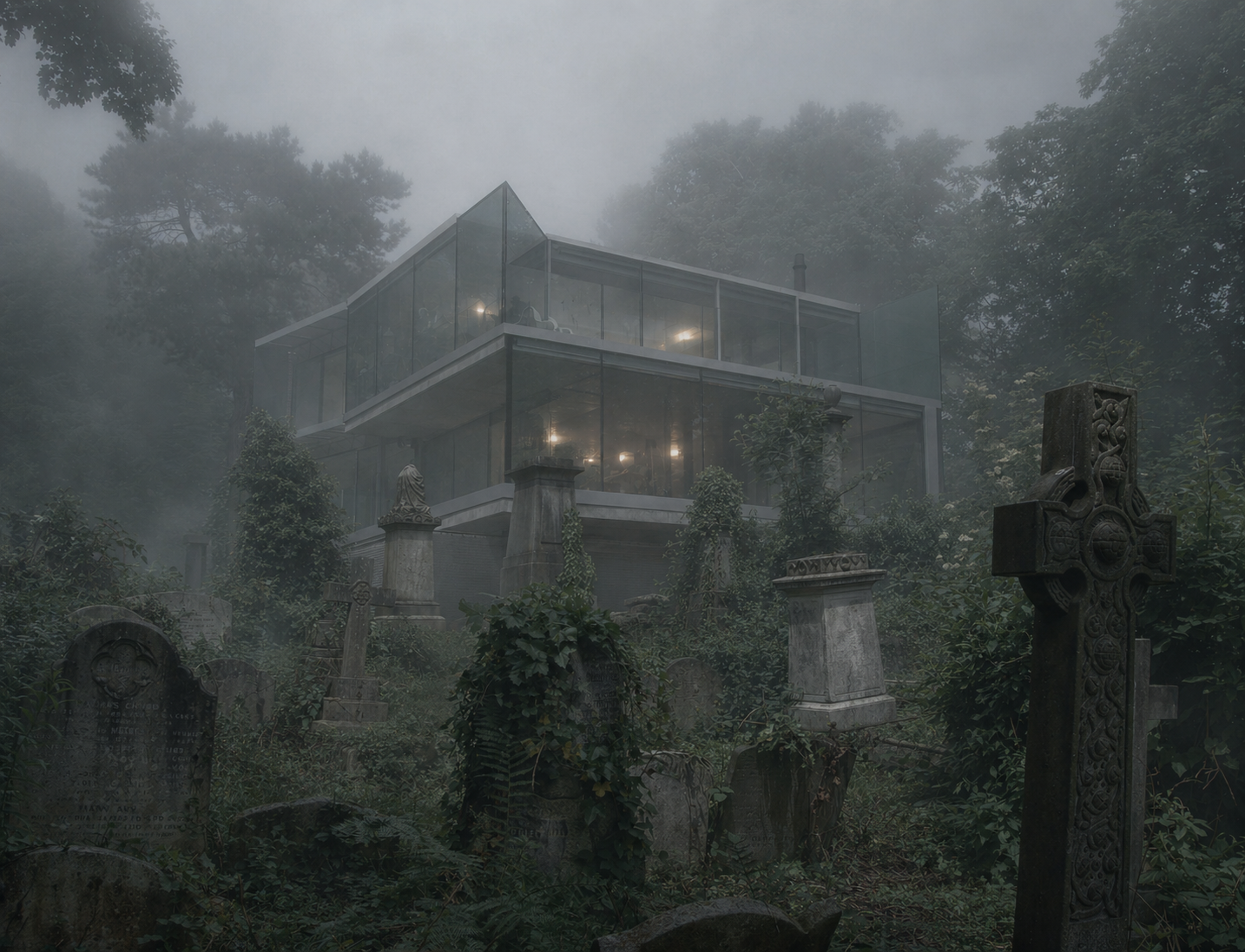
"Death is the great equaliser. But in London, it somehow managed to become the great divider as well."
I. The City That Invented Grief
London is the city where death ceased to be a private matter and became public architecture.
At the dawn of the nineteenth century, the British capital faced a crisis no age had prepared it for: the population had surpassed one million and continued to climb. Parish churchyards were suffocating. Bodies were stacked in layers. Quicklime was poured directly onto coffins to hasten decomposition and make room for the next arrivals. In some districts, the dead were buried in the alleys between houses — only a few feet from the living.
This was not metaphor. This was topography.
In response to this crisis, London created something that would reshape the western relationship with death: seven large private necropolises on the city's outskirts — the so-called Magnificent Seven. Highgate, Kensal Green, Brompton, Abney Park, Nunhead, Norwood, and Tower Hamlets — each conceived not merely as a burial ground but as a landscaped garden, an architectural manifesto, a social institution.
Highgate, the first to open in 1839, became the exemplary code of Victorian death philosophy: Egyptian Avenues, Gothic mausoleums, the Circle of Lebanon — a ring of catacomb vaults encircling an ancient cedar tree. Approximately 170,000 people lie in 53,000 graves here — among them Karl Marx, George Eliot, Michael Faraday, Malcolm McLaren, and George Michael.
Highgate did not merely receive the dead. It transformed farewell into a genre.
II. Black Fashion as Language
When Prince Albert died in 1861, Queen Victoria put on mourning dress. She never took it off. For forty years, until her own death, she wore black.
It was an act of personal grief. But it became a state precedent.
Victorian death culture is among the most codified in human history. It had its own vocabulary, its own dress code, its own chronology. A widow was required to wear deep mourning — matte black fabrics, no shine, no jewellery save for black Whitby jet — for no less than two years. Then came half-mourning: greys, lavenders, a touch of white. Then, finally, a return to life.
Children wore black for a year. Cousins for a month. Aunts and uncles for six weeks. Everything was regulated. Etiquette manuals for grief existed just as tax-filing guides do today.
Mirrors in the house were draped in black cloth — lest the soul of the deceased become trapped in its own reflection. Clocks were stopped at the moment of death. The coffin was carried out feet first — so the dead could not turn and call someone to follow.
Grief was visible. Grief was material. Grief was mandatory.
For wealthy families, a funeral became theatre. Professional mourners — mutes — stood at the gate in black cloaks and top hats, silent as statues. Hearses were drawn by horses with black plumes. Funeral invitations were sent with black-bordered edges, delivered by hand, as one might dispatch an invitation to a ball.
This was not hypocrisy. It was an architecture of feeling: external form created a container for internal experience. Ritual did not replace grief — it held it.
III. The First World War and the End of Grand Mourning
The First World War killed millions of people. It also killed Victorian mourning.
When the losses began to be counted in hundreds of thousands — most of them buried in foreign soil in France and Belgium — individual farewell lost its meaning. You cannot mourn your husband in deep black for two years when you never saw him dead. You cannot stop the clocks when time has stopped for an entire generation.
By the 1920s, public displays of grief had come to seem inappropriate — almost selfish against a backdrop of collective loss. The black dresses disappeared from the streets. Professional mourners became anachronisms. Elaborate ritual yielded to a brief ceremony.
London began to learn a different code: silence.
This was the moment the British culture of emotional restraint was born — what is called today the stiff upper lip. Not insensibility, but strict discipline of feeling. Not the denial of death — but a refusal of its public theatre.
Paradoxically, this too was a philosophy. Only a different one.
IV. Highgate: Nature as a Code of Memory
Today the western half of Highgate is accessible only on a guided tour. The eastern half can be explored independently.
Walking through the West Cemetery, one encounters something difficult to name simply. Nature here does not decorate death — it absorbs it. Ivy envelops mausoleums. Foxes move between headstones. Trees have grown directly through the foundations of vaults, splitting them from within. None of this is neglect or ruin. It is a different code of memory: organic, non-linear, alive.
The Victorians came here for walks. They held picnics among the graves. This did not strike them as strange — they experienced the cemetery as a landscaped park, a place for reflection, a public space for the encounter between the living and the dead.
There was wisdom in this that we have lost.
Contemporary London has pushed death to the periphery. Hospices are located away from residential neighbourhoods. Crematoria are anonymous industrial buildings. Funeral parlours have curtained windows. Dying has become a specialised process that takes place somewhere out there, beyond the boundaries of daily life.
Highgate stands as a counterargument to this logic. Here death is part of the urban fabric. Here it is not hidden.
V. Modern London: Personalisation in Place of Ritual
By 2015, approximately one in four British funerals was conducted by a non-religious celebrant. That proportion continues to grow.
London is among the most secularised megacities in the world, and also one of the most multicultural. These two facts together produce an interesting effect: the traditional Protestant funeral yields to personalised ceremonies that incorporate video montages, the deceased's favourite songs, unusual venues — pubs, gardens, concert halls.
Death becomes a narrative about a life. The funeral becomes an exhibition of identity.
On one hand, this is a liberation from rigid codes. On the other, it is the loss of a shared language of farewell. When each ceremony becomes unique, the collective ritual disappears — what psychologists call structured grief. It becomes harder for individuals to find themselves within a communal experience of loss.
The Victorians imposed grief. Modern London has privatised it. Both extremes are a form of dysfunction.
VI. What the Architecture Reads
London is a city where death has left visible traces in stone, in city planning, in urban culture. Reading these traces as code, they say something like this:
First: memory requires space. The Magnificent Seven were created because death had nowhere to go. Today death again has no space — not physically, but symbolically. The urban environment makes no provision for an encounter with it.
Second: ritual is not superstition. It is a technology of experience. Victorian mourning etiquette, for all its excess, served a function: it created time, form, and permission for grief. The contemporary personalisation of funerals is an attempt to find a substitute for that technology. No convincing answer has yet emerged.
Third: nature and death are allies, not antagonists. The West Cemetery at Highgate — with its foxes, its ivy, its toppled monuments — recalls that dying is not an anomaly but part of an organic cycle. This idea is one the modern city works hard to suppress.
Fourth: London invented the death industry earlier than anyone else. The first professional funeral directors, the first dedicated mourning shops, the first codified grief regulations — all emerged here, in Victorian Britain. This legacy is ambivalent: it gave death dignity and structure, but it also turned it into a commercial product.
In Lieu of a Conclusion: What We Take from London
Berlin concealed death in historical silence. Moscow held it in the collective monument. London made it part of an industry — first literally, in the undertaking trade, then culturally, in gothic aesthetics, in melancholy, in the entire genre of dark tourism.
This too is a way of working with eternity. Not the deepest — but perhaps the most honest: death exists, it demands effort, and someone charges for those efforts.
Highgate, however, speaks of something else. It says: death can be beautiful. Farewell can be dignified. Memory can live in stone, in fox prints, in ivy — not as a museum exhibit but as a living part of the city.
This, perhaps, is the London code. Not an architecture of forgetting — an architecture of presence.
London is the city where death ceased to be a private matter and became public architecture.
At the dawn of the nineteenth century, the British capital faced a crisis no age had prepared it for: the population had surpassed one million and continued to climb. Parish churchyards were suffocating. Bodies were stacked in layers. Quicklime was poured directly onto coffins to hasten decomposition and make room for the next arrivals. In some districts, the dead were buried in the alleys between houses — only a few feet from the living.
This was not metaphor. This was topography.
In response to this crisis, London created something that would reshape the western relationship with death: seven large private necropolises on the city's outskirts — the so-called Magnificent Seven. Highgate, Kensal Green, Brompton, Abney Park, Nunhead, Norwood, and Tower Hamlets — each conceived not merely as a burial ground but as a landscaped garden, an architectural manifesto, a social institution.
Highgate, the first to open in 1839, became the exemplary code of Victorian death philosophy: Egyptian Avenues, Gothic mausoleums, the Circle of Lebanon — a ring of catacomb vaults encircling an ancient cedar tree. Approximately 170,000 people lie in 53,000 graves here — among them Karl Marx, George Eliot, Michael Faraday, Malcolm McLaren, and George Michael.
Highgate did not merely receive the dead. It transformed farewell into a genre.
II. Black Fashion as Language
When Prince Albert died in 1861, Queen Victoria put on mourning dress. She never took it off. For forty years, until her own death, she wore black.
It was an act of personal grief. But it became a state precedent.
Victorian death culture is among the most codified in human history. It had its own vocabulary, its own dress code, its own chronology. A widow was required to wear deep mourning — matte black fabrics, no shine, no jewellery save for black Whitby jet — for no less than two years. Then came half-mourning: greys, lavenders, a touch of white. Then, finally, a return to life.
Children wore black for a year. Cousins for a month. Aunts and uncles for six weeks. Everything was regulated. Etiquette manuals for grief existed just as tax-filing guides do today.
Mirrors in the house were draped in black cloth — lest the soul of the deceased become trapped in its own reflection. Clocks were stopped at the moment of death. The coffin was carried out feet first — so the dead could not turn and call someone to follow.
Grief was visible. Grief was material. Grief was mandatory.
For wealthy families, a funeral became theatre. Professional mourners — mutes — stood at the gate in black cloaks and top hats, silent as statues. Hearses were drawn by horses with black plumes. Funeral invitations were sent with black-bordered edges, delivered by hand, as one might dispatch an invitation to a ball.
This was not hypocrisy. It was an architecture of feeling: external form created a container for internal experience. Ritual did not replace grief — it held it.
III. The First World War and the End of Grand Mourning
The First World War killed millions of people. It also killed Victorian mourning.
When the losses began to be counted in hundreds of thousands — most of them buried in foreign soil in France and Belgium — individual farewell lost its meaning. You cannot mourn your husband in deep black for two years when you never saw him dead. You cannot stop the clocks when time has stopped for an entire generation.
By the 1920s, public displays of grief had come to seem inappropriate — almost selfish against a backdrop of collective loss. The black dresses disappeared from the streets. Professional mourners became anachronisms. Elaborate ritual yielded to a brief ceremony.
London began to learn a different code: silence.
This was the moment the British culture of emotional restraint was born — what is called today the stiff upper lip. Not insensibility, but strict discipline of feeling. Not the denial of death — but a refusal of its public theatre.
Paradoxically, this too was a philosophy. Only a different one.
IV. Highgate: Nature as a Code of Memory
Today the western half of Highgate is accessible only on a guided tour. The eastern half can be explored independently.
Walking through the West Cemetery, one encounters something difficult to name simply. Nature here does not decorate death — it absorbs it. Ivy envelops mausoleums. Foxes move between headstones. Trees have grown directly through the foundations of vaults, splitting them from within. None of this is neglect or ruin. It is a different code of memory: organic, non-linear, alive.
The Victorians came here for walks. They held picnics among the graves. This did not strike them as strange — they experienced the cemetery as a landscaped park, a place for reflection, a public space for the encounter between the living and the dead.
There was wisdom in this that we have lost.
Contemporary London has pushed death to the periphery. Hospices are located away from residential neighbourhoods. Crematoria are anonymous industrial buildings. Funeral parlours have curtained windows. Dying has become a specialised process that takes place somewhere out there, beyond the boundaries of daily life.
Highgate stands as a counterargument to this logic. Here death is part of the urban fabric. Here it is not hidden.
V. Modern London: Personalisation in Place of Ritual
By 2015, approximately one in four British funerals was conducted by a non-religious celebrant. That proportion continues to grow.
London is among the most secularised megacities in the world, and also one of the most multicultural. These two facts together produce an interesting effect: the traditional Protestant funeral yields to personalised ceremonies that incorporate video montages, the deceased's favourite songs, unusual venues — pubs, gardens, concert halls.
Death becomes a narrative about a life. The funeral becomes an exhibition of identity.
On one hand, this is a liberation from rigid codes. On the other, it is the loss of a shared language of farewell. When each ceremony becomes unique, the collective ritual disappears — what psychologists call structured grief. It becomes harder for individuals to find themselves within a communal experience of loss.
The Victorians imposed grief. Modern London has privatised it. Both extremes are a form of dysfunction.
VI. What the Architecture Reads
London is a city where death has left visible traces in stone, in city planning, in urban culture. Reading these traces as code, they say something like this:
First: memory requires space. The Magnificent Seven were created because death had nowhere to go. Today death again has no space — not physically, but symbolically. The urban environment makes no provision for an encounter with it.
Second: ritual is not superstition. It is a technology of experience. Victorian mourning etiquette, for all its excess, served a function: it created time, form, and permission for grief. The contemporary personalisation of funerals is an attempt to find a substitute for that technology. No convincing answer has yet emerged.
Third: nature and death are allies, not antagonists. The West Cemetery at Highgate — with its foxes, its ivy, its toppled monuments — recalls that dying is not an anomaly but part of an organic cycle. This idea is one the modern city works hard to suppress.
Fourth: London invented the death industry earlier than anyone else. The first professional funeral directors, the first dedicated mourning shops, the first codified grief regulations — all emerged here, in Victorian Britain. This legacy is ambivalent: it gave death dignity and structure, but it also turned it into a commercial product.
In Lieu of a Conclusion: What We Take from London
Berlin concealed death in historical silence. Moscow held it in the collective monument. London made it part of an industry — first literally, in the undertaking trade, then culturally, in gothic aesthetics, in melancholy, in the entire genre of dark tourism.
This too is a way of working with eternity. Not the deepest — but perhaps the most honest: death exists, it demands effort, and someone charges for those efforts.
Highgate, however, speaks of something else. It says: death can be beautiful. Farewell can be dignified. Memory can live in stone, in fox prints, in ivy — not as a museum exhibit but as a living part of the city.
This, perhaps, is the London code. Not an architecture of forgetting — an architecture of presence.