The River of Eternity: Beauty as the language of farewell in Ancient Egypt
They understood something we have almost forgotten: departure requires beauty. Not as decoration. Not as consolation. As a condition of passage.
Ancient Egypt gave the world its most elaborate funeral culture — and at its heart lay not merely religious obligation, not merely fear of oblivion. At its heart lived a conviction: that beauty is the language the gods understand. That only a beautifully composed farewell opens the door to eternity.
The Body as First Temple
Long before the body was placed in its sarcophagus, it became an object of ritual art. Embalming lasted seventy days — a number aligned with the cycle of Sirius, the star whose appearance on the horizon announced the flooding of the Nile and, with it, the promise of renewal. Each of those seventy days carried its own action, its own oil, its own prayer.
The internal organs were removed and placed into canopic jars — vessels whose lids were carved in the forms of the four sons of Horus: human, baboon, jackal, and falcon. This was not anatomy. It was sculpture. Each organ received its guardian, its name, its place within the cosmic order.
The body was wrapped in linen bandages saturated with cedar oil, myrrh, and natron. Fragrance was not incidental — it was part of the ritual: aromatic resins repelled decay while simultaneously becoming offerings to the invisible. Between the layers of cloth, embalmers placed amulets: lapis lazuli scarabs, gold pendants inscribed with hieroglyphs, heart scarabs bearing texts that would speak on behalf of the deceased before the tribunal of Osiris.
The body became a book. The body became a jewel. The body became architecture.
The Mask: A Face for Eternity
The crowning achievement of this bodily preparation was the mask. For pharaohs — solid gold, inlaid with lapis lazuli, carnelian, and turquoise. For the wealthy — gilded cartonnage with finely rendered features. Even for those of modest means — a painted wooden mask where the artist preserved something of the living face.
The mask of Tutankhamun is not simply a masterpiece of goldwork. It is a manifesto. Its gold signified the flesh of the gods — incorruptible, radiant. The striped nemes headdress, the lapis beard, the obsidian-and-quartz eyes — each element was not ornamentation but declaration: this person has crossed. This person has become.
The beauty of the mask was not luxury in our modern sense. It was a passport. Without the correctly rendered face, the Ba-soul might fail to recognise its body upon return, fail to complete its nightly journey through the Duat and back. Beauty functioned as navigation. Beauty was the compass of the afterlife.
The Sarcophagus: A House Carried on Shoulders
The coffin in Egypt was never merely a box. It was a dwelling — "nut," as Egyptians called it, using the same word as for the sky. Sarcophagi were painted inside and out: scenes from the Book of the Dead, maps of the underworld, protective spells, portraits of guardian deities.
Beginning in the Middle Kingdom, the interior lids of wooden coffins were adorned with images of Nut — goddess of the sky — spreading her arms over the deceased in an eternal embrace. The dead lay, quite literally, inside a goddess. Inside the sky. Inside protection.
The polychrome painting of New Kingdom coffins reached extraordinary refinement: turquoise grounds, ochre hieroglyphs, black outlines executed with a precision born of lifelong training. Craftsmen worked by lamplight in the workshops of Deir el-Medina — an entire village of artists and artisans that existed for no other purpose than creating beauty for the dead.
Beauty that the living would almost never see. Beauty created for the gods. Beauty made for eternity.
The Procession: Theatre of Farewell
The day of burial was a performance. Conscious, directed, choreographed to the last gesture.
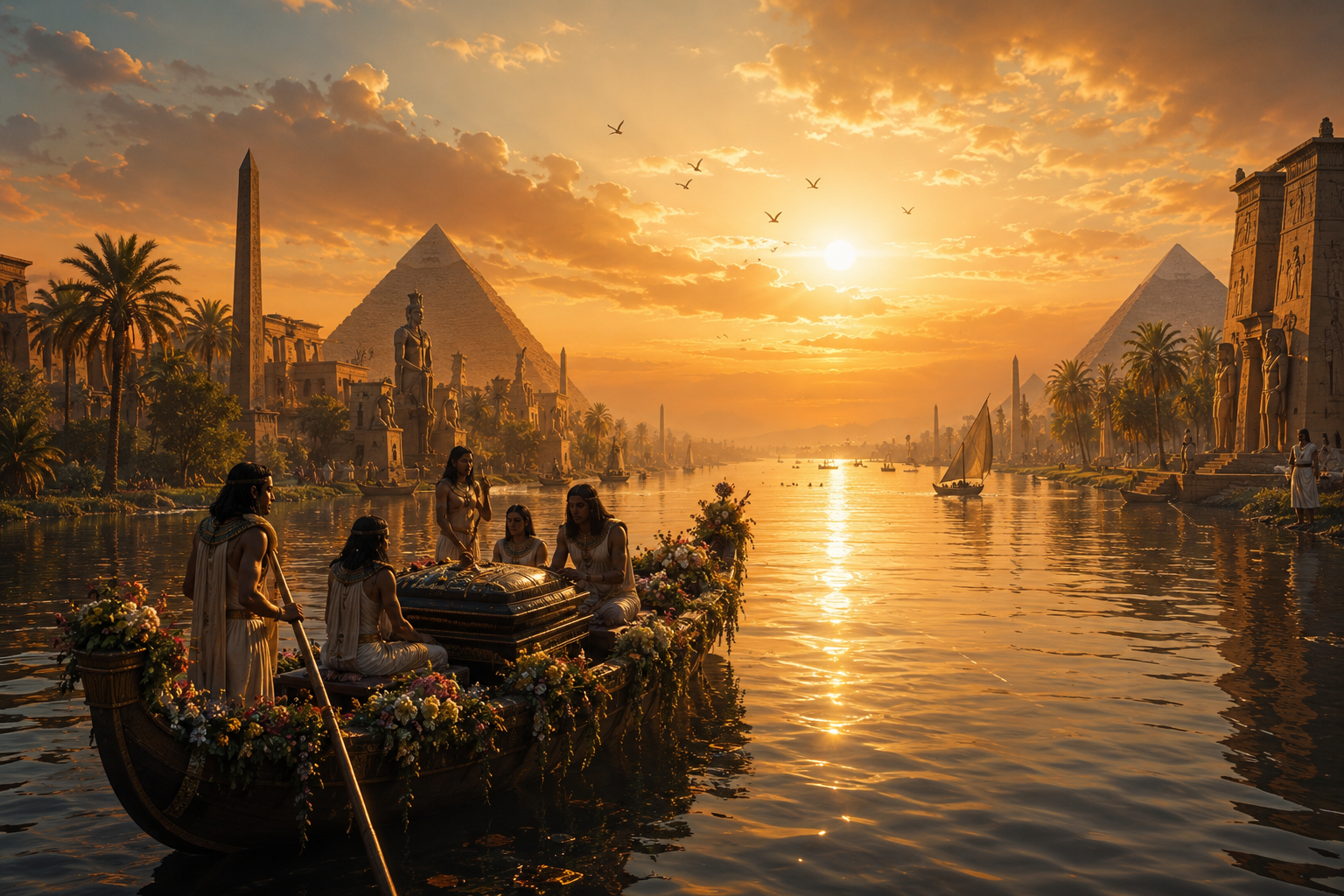
The sarcophagus was drawn on a sledge pulled by oxen, adorned with flower garlands. Ahead walked priests in white linen robes with leopard skins across their shoulders. Behind them — professional mourners, the "khenet," hired specifically for the procession. Their role was not hypocrisy. Their tears and lamentations were the music of passage, the acoustic accompaniment of the soul in transit. They tore their garments, scattered dust upon their heads, raised their arms to the sky — all of it a language addressed to the invisible.
Objects were carried: furniture, vessels of food and wine, caskets of jewellery, tools, toys if the deceased was a child. Each item selected, wrapped, marked. Each item passed through the hands of a craftsman.
Flowers. Flowers were everywhere. Lotus, papyrus, cornflower, mandrake — laid upon the sarcophagus, woven into garlands, scattered across the floor of the burial chamber. In the tomb of Tutankhamun, excavators found wreaths of olive leaves and field flower petals — dry, fragile, having survived three thousand years. Flowers placed by human hands in 1323 BC.
This was not a display of wealth. It was an act of love, translated into the language of beauty.
The Burial Chamber: Architecture of the Eternal Moment
The tomb was not a place of death. It was a house of eternity — "per djet." Architecture, painting, sculpture, and text functioned here as a single organism.
The walls of burial chambers in the Valley of the Kings are inscribed with such density of meaning that Egyptologists continue to decode new layers today. Every colour was a code: blue for sky and water, green for renewal and Osiris, red for the sun and vital force, white for purity, black for fertile earth and death as beginning.
The ceilings of Ramesside tombs were covered with astronomical charts — constellations, lunar phases, planetary movements. The deceased lay beneath a sky rendered with navigational precision. Their final ceiling was a map of the universe.
In the tombs of the nobility — scenes of feasting, hunting, harvest, music, and dance. Not because Egyptians failed to understand that the dead would not rise and hunt. But because the depiction of a beautiful life was itself a magical act: what is painted exists. Recorded joy is eternal.
Beauty as the Language of Eternity
Why? Why such attention to details no living person would ever see? Why devote years to painting a chamber that would be sealed within a month?
Because Egyptians understood: beauty is the only language the gods comprehend. Because the deceased would appear before a tribunal of forty-two divine assessors, and must arrive there with dignity — not only with a pure heart, but in worthy form, within a worthy setting.
Because farewell is the final statement made about a person. And that statement is not made in words.
The beauty of Egypt's funeral culture was neither excess nor fear. It was a conviction that became a civilisation: that a person deserves a beautiful departure as much as they deserve a beautiful life. That the last day is no less significant than the first. That the way we say farewell speaks to how fully we loved.
Three thousand years later, we still have something to learn from those who placed living flowers in the darkness of sealed tombs.
Because beauty given to eternity does not disappear.
It becomes eternity.
Ancient Egypt gave the world its most elaborate funeral culture — and at its heart lay not merely religious obligation, not merely fear of oblivion. At its heart lived a conviction: that beauty is the language the gods understand. That only a beautifully composed farewell opens the door to eternity.
The Body as First Temple
Long before the body was placed in its sarcophagus, it became an object of ritual art. Embalming lasted seventy days — a number aligned with the cycle of Sirius, the star whose appearance on the horizon announced the flooding of the Nile and, with it, the promise of renewal. Each of those seventy days carried its own action, its own oil, its own prayer.
The internal organs were removed and placed into canopic jars — vessels whose lids were carved in the forms of the four sons of Horus: human, baboon, jackal, and falcon. This was not anatomy. It was sculpture. Each organ received its guardian, its name, its place within the cosmic order.
The body was wrapped in linen bandages saturated with cedar oil, myrrh, and natron. Fragrance was not incidental — it was part of the ritual: aromatic resins repelled decay while simultaneously becoming offerings to the invisible. Between the layers of cloth, embalmers placed amulets: lapis lazuli scarabs, gold pendants inscribed with hieroglyphs, heart scarabs bearing texts that would speak on behalf of the deceased before the tribunal of Osiris.
The body became a book. The body became a jewel. The body became architecture.
The Mask: A Face for Eternity
The crowning achievement of this bodily preparation was the mask. For pharaohs — solid gold, inlaid with lapis lazuli, carnelian, and turquoise. For the wealthy — gilded cartonnage with finely rendered features. Even for those of modest means — a painted wooden mask where the artist preserved something of the living face.
The mask of Tutankhamun is not simply a masterpiece of goldwork. It is a manifesto. Its gold signified the flesh of the gods — incorruptible, radiant. The striped nemes headdress, the lapis beard, the obsidian-and-quartz eyes — each element was not ornamentation but declaration: this person has crossed. This person has become.
The beauty of the mask was not luxury in our modern sense. It was a passport. Without the correctly rendered face, the Ba-soul might fail to recognise its body upon return, fail to complete its nightly journey through the Duat and back. Beauty functioned as navigation. Beauty was the compass of the afterlife.
The Sarcophagus: A House Carried on Shoulders
The coffin in Egypt was never merely a box. It was a dwelling — "nut," as Egyptians called it, using the same word as for the sky. Sarcophagi were painted inside and out: scenes from the Book of the Dead, maps of the underworld, protective spells, portraits of guardian deities.
Beginning in the Middle Kingdom, the interior lids of wooden coffins were adorned with images of Nut — goddess of the sky — spreading her arms over the deceased in an eternal embrace. The dead lay, quite literally, inside a goddess. Inside the sky. Inside protection.
The polychrome painting of New Kingdom coffins reached extraordinary refinement: turquoise grounds, ochre hieroglyphs, black outlines executed with a precision born of lifelong training. Craftsmen worked by lamplight in the workshops of Deir el-Medina — an entire village of artists and artisans that existed for no other purpose than creating beauty for the dead.
Beauty that the living would almost never see. Beauty created for the gods. Beauty made for eternity.
The Procession: Theatre of Farewell
The day of burial was a performance. Conscious, directed, choreographed to the last gesture.
The sarcophagus was drawn on a sledge pulled by oxen, adorned with flower garlands. Ahead walked priests in white linen robes with leopard skins across their shoulders. Behind them — professional mourners, the "khenet," hired specifically for the procession. Their role was not hypocrisy. Their tears and lamentations were the music of passage, the acoustic accompaniment of the soul in transit. They tore their garments, scattered dust upon their heads, raised their arms to the sky — all of it a language addressed to the invisible.
Objects were carried: furniture, vessels of food and wine, caskets of jewellery, tools, toys if the deceased was a child. Each item selected, wrapped, marked. Each item passed through the hands of a craftsman.
Flowers. Flowers were everywhere. Lotus, papyrus, cornflower, mandrake — laid upon the sarcophagus, woven into garlands, scattered across the floor of the burial chamber. In the tomb of Tutankhamun, excavators found wreaths of olive leaves and field flower petals — dry, fragile, having survived three thousand years. Flowers placed by human hands in 1323 BC.
This was not a display of wealth. It was an act of love, translated into the language of beauty.
The Burial Chamber: Architecture of the Eternal Moment
The tomb was not a place of death. It was a house of eternity — "per djet." Architecture, painting, sculpture, and text functioned here as a single organism.
The walls of burial chambers in the Valley of the Kings are inscribed with such density of meaning that Egyptologists continue to decode new layers today. Every colour was a code: blue for sky and water, green for renewal and Osiris, red for the sun and vital force, white for purity, black for fertile earth and death as beginning.
The ceilings of Ramesside tombs were covered with astronomical charts — constellations, lunar phases, planetary movements. The deceased lay beneath a sky rendered with navigational precision. Their final ceiling was a map of the universe.
In the tombs of the nobility — scenes of feasting, hunting, harvest, music, and dance. Not because Egyptians failed to understand that the dead would not rise and hunt. But because the depiction of a beautiful life was itself a magical act: what is painted exists. Recorded joy is eternal.
Beauty as the Language of Eternity
Why? Why such attention to details no living person would ever see? Why devote years to painting a chamber that would be sealed within a month?
Because Egyptians understood: beauty is the only language the gods comprehend. Because the deceased would appear before a tribunal of forty-two divine assessors, and must arrive there with dignity — not only with a pure heart, but in worthy form, within a worthy setting.
Because farewell is the final statement made about a person. And that statement is not made in words.
The beauty of Egypt's funeral culture was neither excess nor fear. It was a conviction that became a civilisation: that a person deserves a beautiful departure as much as they deserve a beautiful life. That the last day is no less significant than the first. That the way we say farewell speaks to how fully we loved.
Three thousand years later, we still have something to learn from those who placed living flowers in the darkness of sealed tombs.
Because beauty given to eternity does not disappear.
It becomes eternity.
Articles
Iskandar Kadyrov | The VOYAGER Journal
See also