The King's Last Journey
I. THE KING LEAVES THE PALACE
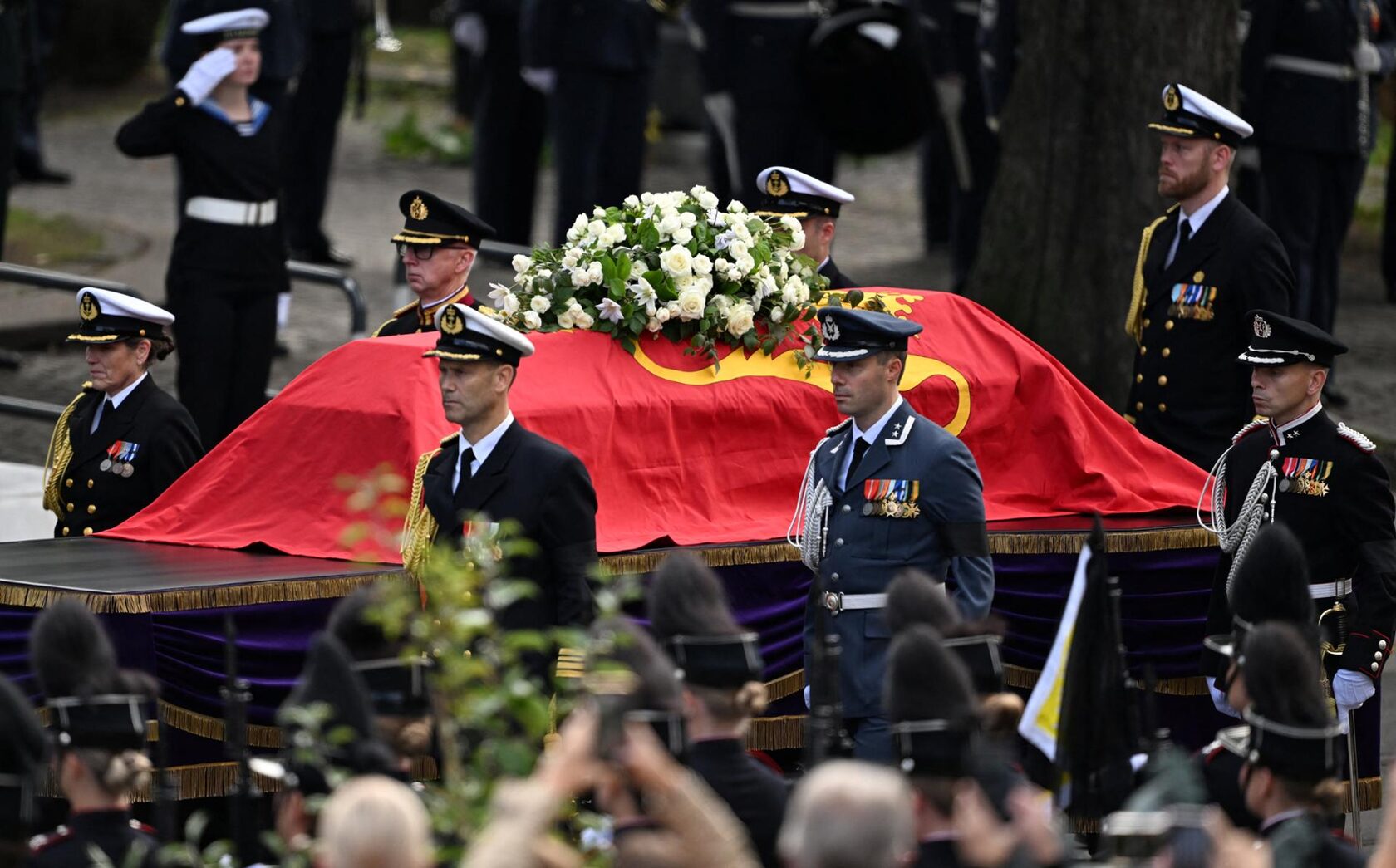
At noon on 9 September 2026, the coffin of King Harald V left the Royal Palace in Oslo. It was carried on a gun carriage, as prescribed for the funeral of a reigning monarch. The coffin was draped in Norway's red royal banner, topped with white flowers.
This was not merely a procession. This was an exit. The final exit of a man who had been the embodiment of a nation for nearly thirty-five years.
Harald died on 28 August at the age of 89 after a prolonged period of illness. For thirteen days, the country lived in national mourning. Flags flew at half-mast. The Palace became a place of pilgrimage: thousands of Norwegians came to its walls, leaving flowers, candles, and national flags.
The King lay in state in the Palace Chapel, and the public was able to file past his coffin to pay their respects. This was not a formality. It was an opportunity for the nation — for every individual — to see that death is real. That the King, often regarded as a kind of grandfather of the nation, had truly gone.
II. THE CITY WALKS WITH HIM
A funeral procession is not just a route. It is a text written by the body of the city.
At one o'clock, the coffin was brought to Oslo Cathedral. Around 1,900 soldiers lined the route, forming a ceremonial corridor. A further 3,500 Armed Forces personnel took part in the commemorations. Bells rang. A minute of silence was observed across Norway — it began and ended with three strokes of the bells.
In a cathedral designed for about eight hundred, nearly a thousand gathered that day. Kings, presidents, heirs to thrones, representatives of states — the world came not so much to escort a monarch as to witness the end of an era. Among them were King Carl XVI Gustaf of Sweden, King Frederik X of Denmark, King Felipe VI of Spain, King Willem-Alexander of the Netherlands, King Philippe of Belgium, Prince William of Wales, and Princess Anne. Ukraine's President Volodymyr Zelensky also attended the service.
But more important than the guest list was the presence of people in the streets. Tens of thousands of Norwegians lined the streets of Oslo to see off their King. Anders Aanerud, a 37-year-old municipal employee, told AFP: "He was king for practically my whole life. I thought it was normal to come today, since I could".
This is not a crowd. This is a nation in motion. The funeral procession passes through the city not so that the coffin can disappear behind closed doors, but so that everyone can witness the passage. The city does not hide death. The city walks alongside it.
III. THE RITUAL OF A NATION
A state funeral is a language. And this language consists of details, each of which carries meaning.
A 21-gun salute. A minute of silence. Bells. The red royal banner. A military cortège.
And one more detail I want to highlight. F-35 fighter jets in a "missing man" formation — four aircraft flew over the cathedral, one of them pulling away from the formation. The empty space in the sky symbolised the loss. The aircraft climbing away — the final journey. It was the architecture of the last voyage, written in the sky.
These elements are not decorations. They are the architecture of ritual — the way a state speaks of death. When traditional religious frameworks weaken, it is precisely these secular ceremonies that become the container holding collective grief.
Harald was a Lutheran king, yet his funeral was also a profoundly civic act. Bishop of Oslo Sunniva Gylver and Presiding Bishop Olav Fykse Tveit led the service. Cathedral organist Marcus André Berg and the Oslo Cathedral Choir provided the music. Religion and state, faith and ceremony — here they do not contradict each other, but complement.
IV. AKERSHUS: THE ARCHITECTURE OF ETERNITY
After the service in the cathedral, the procession moved to Akershus Fortress — the medieval citadel overlooking Oslo Fjord.
There, in the crypt of the Palace Chapel, King Harald was laid to rest. He was placed in a sarcophagus designed by the renowned Norwegian architectural firm Snøhetta — the same firm behind the Oslo Opera House. The sarcophagus has been reported to be valued at around $2 million. Its design remains secret. It is intended for both Harald and his wife, Queen Sonja.
And here a theme emerges that I want to emphasise. The final object that accompanies a person beyond death was designed by architects while he was still alive. This is not merely a royal funeral. This is the architecture of eternity.
Akershus Fortress was founded in the 13th century. It has survived sieges, fires, occupation. But its crypt has become the eternal resting place of Norwegian monarchs. Beside Harald rest his parents — King Olav V and Queen Maud — and his grandfather, King Haakon VII.
The mausoleum was consecrated in 1949, after the death of Queen Maud in 1938. Since then, it has remained closed to the public. We know of it through descriptions, rare photographs, official statements. But its very impenetrability is part of the language. The mystery surrounding the place of eternal rest speaks louder than any public spectacle.
V. WHEN THE COFFIN DISAPPEARS
The most important part of the ceremony is the one after which nothing happens.
After the private service in the Akershus chapel, flags across Norway were raised from half-mast to the top. Church bells rang for an hour. Mourning was over. The country returned to life.
Members of the royal family appeared on the balcony of the Royal Palace and waved to the crowd. Haakon VIII — the new King of Norway — stood beside his wife, Queen Mette-Marit, and their daughter, Crown Princess Ingrid Alexandra.
An important constitutional nuance: Haakon became king the moment his father died. But only now, after the burial, did the country see that transition in its full ceremonial completeness. The death of one monarch became, literally, the transition of a state from one era to another.
It is in this moment — when the coffin disappears into the crypt, and the new king steps onto the balcony — that it becomes clear: the funeral of a sovereign is not only a farewell to a person. It is the ritual through which the living reorganise the world after death.
CONCLUSION: THE ARCHITECTURE OF FAREWELL
Norway said goodbye to Harald V quietly. Without the visual noise that often accompanies state ceremonies.
But it is precisely in this quiet — in the bells, in the minute of silence, in the slow movement of the procession through the city — that the power lies. The Norwegian ritual of farewell does not try to defeat death. It accepts it. It makes it part of the national narrative. It turns the departure of a king into a moment when the nation becomes conscious of itself again.
Harald completed his journey. Haakon VIII was already king. But it was on this day that the country first saw the transition from one reign to another completed.
And in this transition — in this precise, calibrated architecture of farewell — Norway showed that a state can speak of death not in a whisper, not in a shout, but in a clear, calm voice.
A voice that is heard.
Articles
Iskandar Kadyrov | The VOYAGER Journal
See also